Wine Economist | Lenz Moser’s Mad Mád Mád Mad Wine World
A winemaker from Austria making white Cabernet Sauvignon wines in China. It seemed like a crazy idea. But, as we reported here in The Wine Economist a couple of months ago, it really worked. Crazy, but true.
World Wine Ambitions
The winemaker is Lenz Moser and his Chateau Changyu Moser XV wines made us believers. We had to find out more.
Moser is the 15th generation of his family (hence Moser XV above) to make wines in Austria, but he obviously has world wine ambitions. He spent a decade working for Robert Mondavi, for example, and brought what he learned home in terms of making wines to appeal to international markets. He identifies as a consumer and seeks to craft wines that people will enjoy.
One problem with the Chateau Changyu Moser wines is that they are not currently available in the U.S. market (it’s complicated, but I assume that U.S.-China trade issues are part of the story). So we have been focusing on Moser wines in U.S. distribution.
Gruner Pastures?
It is not surprising that an Austrian winemaker would make wine from Austria’s signature grape variety: Gruner Veltliner. Less probable, I suppose, is that Moser would seek to reimagine the wine as he has done with his New Chapter wines. New Chapter aims to leapfrog evolution, producing “tomorrow’s Gruner today,” by which I think is meant to make Gruner more consumer-friendly without sacrificing its essence.
I admit that I don’t drink Gruner often enough to evaluate the “to the future … and beyond” claim, but I can verify that the wine quickly disappeared over lunch with our friend Mary. A good start to our investigation.
Mád Mad Moser
Our friends Lisa and John recently returned from a trip to Budapest, so they were logical guests to help us get to know Lenz Moser’s line of Hungarian wines, three variations on Furmint from the Tokaj region. How much more Hungarian can you get?
The wines are called Mad Moser (or sometimes Mád Moser) because they are made in partnership with the Mad Wine company located in the city of Mád. Mád Mad Moser for sure.
The first wine we sampled was a dry Furmint (labeled Mád Moser) made in a modern style (think stainless steel). It was distinctive and made us think a bit about where Furmint fits into the Central European wine matrix that includes Gruner and Riesling along with other white wines.
The second wine (labeled Mad Moser) was also a dry Furmint, but quite different from the first, having spent eight months in Hungarian oak casks and barrels. It was more complex, nuanced, drinkable. And it paired really well with our dinner of orecchiette with speck and peas.
The contrast between the two dry Furmint wines was striking and I’d enjoy repeating the experiment. I wish the wine labels provided more information to help consumers know what to expect (not everyone is going to be able to open the two wines side-by-side like we did). I admit that there was a lot of information on the back label, but it was in such tiny print as to be useless even in bright light (I can’t imagine trying to read it in a dimly lit restaurant). I guess I will have to try to remember how Mád differs from Mad and which one we preferred (Mad, I think).
We finished with an elegant Mad Moser Tokaji Aszu 2013, a real treat. It was well balanced and paired perfectly with Sue’s Sicilian almond cookies. A great way to end the meal. John and Lisa commented that the wine was much drier than they expected (a good feature, they said).
Tokaji was once celebrated as the King of Wines and the Wine of Kings, but it is under-appreciated today. Maybe Lenz Moser is a bit mad to try to draw our attention to it and its dry Furmint cousins, but we hope he succeeds.
>>><<<
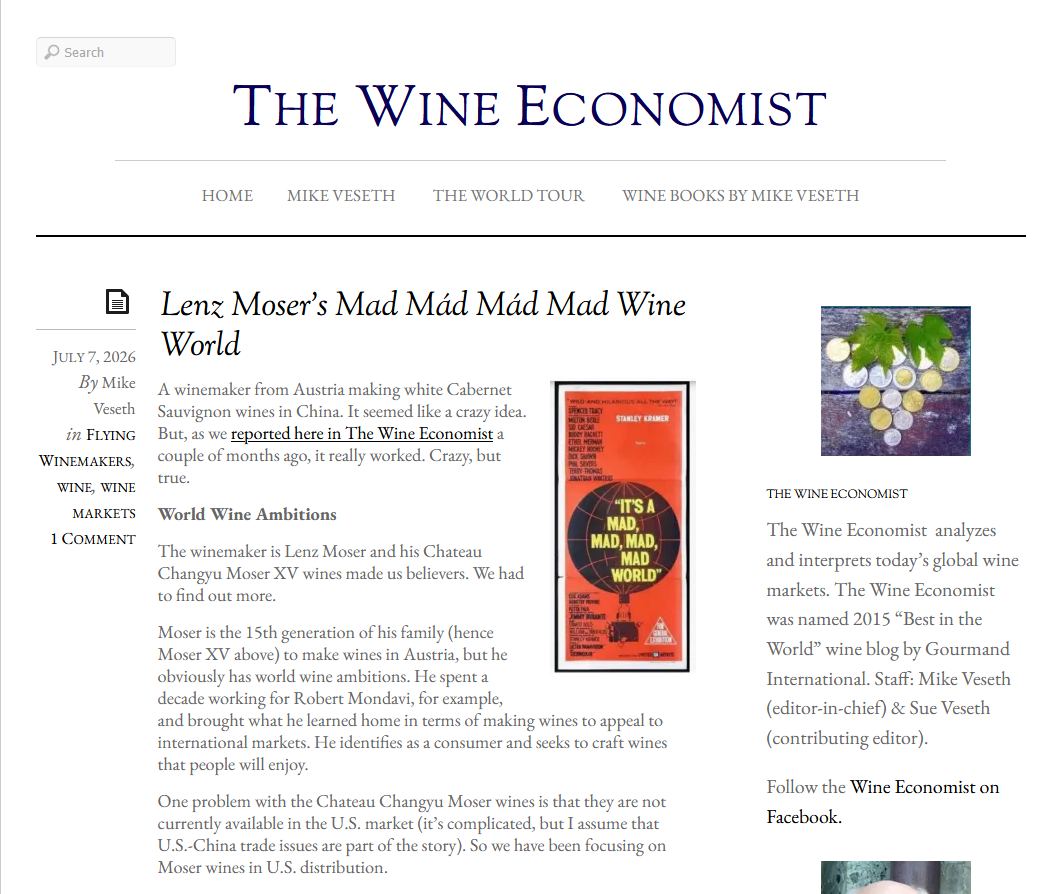
The title of today’s column was inspired by Stanley Kramer’s 1963 film, It’s a Mad, Mad, Mad, Mad World.